You don't need to be a healthcare professional to save a life.
When someone suffers a cardiac arrest outside hospital, the people around them become the first responders. In critical emergencies, time is of the essence, and the role of these responders is crucial to achieving a good outcome while Emergency Services are activated.
The gap is clear.
out-of-hospital cardiac arrest cases attended by National Ambulance in a one-year study.
of cases occurred at home or in a residence.
of arrests were witnessed.
had an AED applied by a bystander before National Ambulance arrived.
Though a cardiac arrest can happen anywhere, in the UAE study almost 7 in 10 occurred in a home or residence.
That means the person most likely to be nearby may be a family member, friend, colleague or other member of the public. CPR is not simply a skill for healthcare professionals. It is a skill for communities.
Source: National Ambulance out-of-hospital cardiac arrest study, UAE. Full reference to be added.
Early action should begin before the ambulance arrives.
In the National Ambulance study, the median time from ambulance dispatch to arrival at the scene was 11.2 minutes. The chances of surviving decrease by approximately 7–10% for every minute without effective CPR. Drag the marker to see what the wait means.
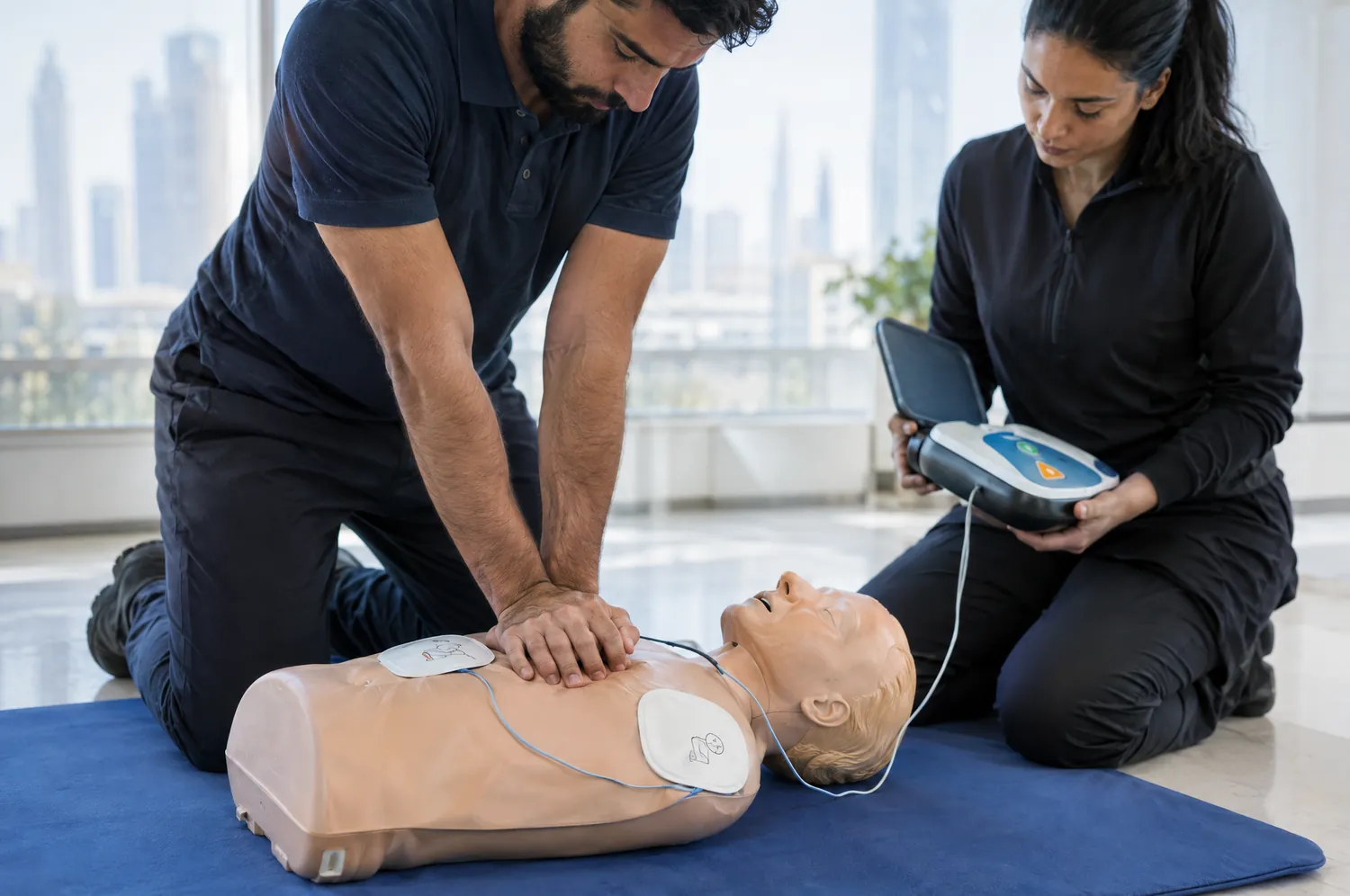
Starting CPR straight away, and using an AED as soon as one arrives, is what keeps that chance alive until the ambulance gets there.
Five steps anyone can learn.

Trained people are the ones who step in.
A 2026 UAE study of 1,020 adults found that prior training was the strongest and most consistent predictor of willingness to perform CPR and use an AED. Confidence, repeated training and recognition of cardiac arrest were associated with greater willingness to intervene.
Source: 2026 UAE study of 1,020 adults. Full reference to be added.
We want to help create a community where people don't stand back and wait for help to arrive.
Would you know what to do if someone you love suddenly collapsed?
Training can turn uncertainty into action.
Learn CPR. Be ready to save a life.
Training for families, schools, workplaces and community groups.